
The City of Peace


After several days in Tokyo, it was time to say goodby to the city and the lovely Mandarin Oriental Hotel. I had booked another flight with All Nippon Airways and, as this was a domestic flight to Hiroshima, it departed from close-in Haneda Airport. That airport is only a short, nine-mile distance from the hotel and it didn’t take long for my taxi to navigate the Tokyo traffic. Despite being one of the largest cities on Earth, Central Tokyo rarely suffers from the gridlock seen in cities like New York or London. This is due to an incredibly robust public transport system, very high costs for car ownership, and strict laws requiring proof of a parking space before one is even permitted to buy a vehicle! Once at Haneda, I checked in for my flight at the ANA Premium Class check-in facilities in Terminal 2 located at the south side of the lobby, which allowed Business Class passengers to check in and drop bags away from the main crowds. The airline operates two ANA lounges, one each on the north and south sides and, as I was departing from Gate 54, I opted to visit the ANA Lounge located on the third floor of the south side near Gate 62.

This large lounge had an open-concept space with seating for more than 900 persons, featuring plush lounge chairs alongside single-use workstation cubicles, all of which had ample universal power outlets at most seats. I particularly liked the floor-to-ceiling windows which were perfect for plane spotting. Complimentary beer from automatic pourers was available as well as spirits, coffee and soft drinks, along with a buffet highlighted by light snacks such as bread, miso soup, and rice balls. Several surprising finds included the dedicated smoking room and private, soundproof phone booths, things you just don’t see very often (if ever) anymore at US airports. This ANA Lounge was equipped with high-speed Wi-Fi and copying/printing facilities, and featured a family/nursing room and a multi-purpose lavatory. Passengers flying in ANA Premium Class, ANA Super Diamond Service members, Platinum Service members, Super Flyers and Star Alliance Gold members were all eligible to access the lounge. Although it was quite large, I found it a quiet place to work and relax before boarding began in the early afternoon.

The carrier was operating a B767-300ER aircraft on the route to Hiroshima that day and I was welcomed aboard and shown to aisle Seat 2C on the port side of the aircraft. There were only ten seats in the forward cabin in a 2-1-2 configuration across two rows. Each seat was 21” wide with a 7” recline and a generous 50” pitch. They were equipped with adjustable foot rests and goose-neck reading lights. The seat pairs on either side also had extendable privacy divider screens. Every seat in the cabin was also equipped with a 12.1” touch screen display monitor, a universal power plug and UBS socket. Waiting at each seat were slippers, headphones and a thick blanket. We received a high-quality bento-style meal on this brief flight featuring seasonal Japanese ingredients served on fine china, accompanied by complimentary beer, sake and wines. For this one-hour and 20-minute flight, ANA Premium Class offered a very nice and comfortable experience. We landed at the Hiroshima Airport (HIJ) around 3:00 PM and I was in a taxi to the hotel within a half hour.

Some forty-five minutes later, I arrived at the Sheraton Grand Hiroshima Hotel, a premium, 4.5-star property located within the Active-Inter City Hiroshima Complex, a mixed-use development also housing office and retail space. Highly favored by travelers, the hotel’s 238 guest rooms were situated on floors 7 through 21 and, averaging 377 square feet, were considered quite large by Japanese standards. The hotel had direct, covered access to the Shinkansen (bullet train) Station serving local and long-distance train lines and bus terminals. My room on the 20th floor Club Level featured a plush, king-sized bed and floor-to-ceiling windows to take in the city skyline view. Along with high-speed Wi-Fi, the room was equipped with a work desk, in-room safe, flat-screen TV and a spacious bathroom featuring Gilchrist & Soames amenities, a large, deep-soaking tub, rainfall shower head, a plush bathrobe and separate frosted-glass doors for both the shower and commode.
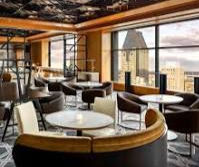
The two-level Sheraton Grand Club Lounge offered a slew of complimentary perks, including a breakfast spread with both Japanese and American options as well as offerings from the menu. Afternoon tea time saw presentations of light bites, sandwiches and free-flowing beverages, while the evening happy hour included self-serve hot and cold hors d’oeuvres, desserts, beer, wines and spirits, including local sakes. Club level guests also received complimentary access to the hotel’s indoor pool and sauna. I can't say enough about the Club Level staff who were so welcoming and helpful, making my stay extremely pleasurable.

When it was time to play tourist, I immediately headed over to the Hiroshima Peace Memorial Park. It’s dedicated to the legacy of Hiroshima as the world’s first city to suffer a nuclear attack and to the memories of the bomb’s direct and indirect victims. Situated prominently on the northern edge of the park grounds along the Motoyasu River is the Atomic Bomb Dome (Genbaku Dome), the skeletal ruin of the former Hiroshima Prefecture Industrial Hall. On August 6, 1945, the US-dropped atomic bomb exploded about 2,000 feet from the building Because the blast detonated almost directly overhead, the building’s vertical columns withstood the immense downward force. While everyone inside was instantly killed and the interior gutted by raging fires, the outer walls and distinct steel-framed dome miraculously remained intact. The dome is now a UNESCO World Heritage Site and serves as a testament to the horrors of nuclear weapons. It was indeed sobering to see the site with my feet firmly planted on the very ground that had witnessed such unimaginable devastation and human suffering.

For a change of pace from city life, I braved the public transportation system on the following day to travel to Miyajima, Luckily, English signage was prevalent. The locals were also easily approachable and the English speakers among them were happy to assist a “lost” American. Miyajima was a 30-minute train ride from central Hiroshima to Miyajimaguchi Station and from there, it was a quick 10-minute ferry ride across to the island. Miyajima is a sacred island in Japan’s Seto Inland Sea, which is famous for the UNESCO World Heritage-listed Itsukushima Shrine. Dedicated to the three Shinto goddesses of seas and storms, the shrine's first iteration dates back to the Sixth Century, with the current vibrant structures established in 1168. Because the entire island was traditionally considered sacred, commoners were forbidden to set foot on it. To visit without violating the holy ground, the shrine was built on stilts over the tidal flat so at high tide, the boardwalks, prayer halls, and stage appear to drift above the sea. Unfortunately, I didn’t get to witness that, but it was an impressive sight to behold nevertheless. The iconic Torii Gate stood over 50 feet high offshore, and the giant wooden gate welcomed boats and worshippers. As my visit occurred at low tide, we were able to actually walk out across the seabed and view the gate up close and study its massive pillars. It was a marvel of engineering, made even more incredible by its being over 800 years old!
All good things must come to an end and so it was with my visit to Hiroshima. I consider myself incredibly fortunate to have visited this vibrant metropolis and would happily return should the occasion arise.
Until next time...safe travels.


The article about the City of Peace is really thoughtful because it highlights calm surroundings, history, and the meaning behind peaceful living. I once read similar travel stories during a busy semester when I had many submissions, so I used do my assignment to complete my coursework and still explore inspiring places like this. It reminded me that peace in life often comes from managing time well.