
Busy First Day in Seattle


I was wide awake at 3:30 in the morning on Thursday, our first full day in Seattle, which of course translated to 6:30 on the East Coast. After finishing up some work, I went downstairs to the Aviation Expo registration desk to pick up my badge and supplementary conference materials. Connor McCauley, one of the convention organizers, had devised a personalized calendar schedule for each attendee whereby one could see at a glance all tours, seminars and or lectures for which one had registered. Also, unlike Airliners International, there were no tour tickets. Our names were to be checked off prior to boarding the transportation for each event. This eliminated the possibility of losing any paper tickets. These were both very good ideas and met with great approval. I met up with Dave in due course. We were excited for what lie ahead during this inaugural aviation show.

Our first event that morning was the Alaska Airlines Hangar Tour. We were able to walk the half mile from the DoubleTree Hotel to the airline’s Maintenance and Engineering Hangar #1. On arrival, we received a special behind-the-scenes look at how Seattle’s hometown airline inspects, repairs and maintains its fleet at this heavy maintenance operation next to SEA-TAC Airport. The tour featured rare and exclusive access to technical areas like the engine shop (where massive motors were removed and serviced) and the sheet metal shop, all of which gave us the opportunity to see Alaska’s commercial and cargo fleet on an up close and personal basis. We also learned how the carrier manages major overhauls and collaborates with other airlines for shared parts and heavy maintenance support.
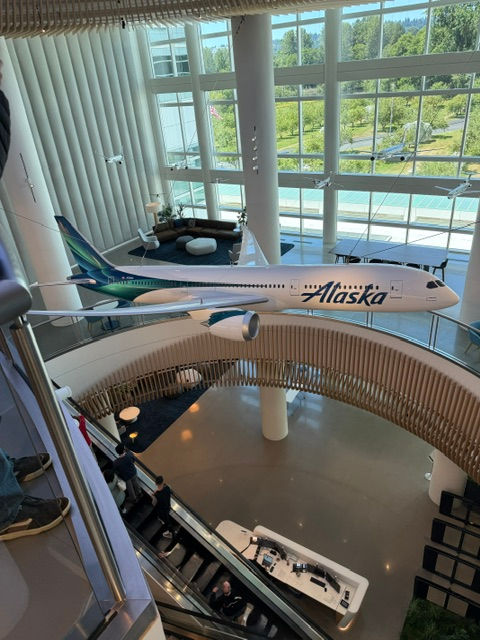
We had about an hour before our next tour of the Alaska Airlines Global Training Center, which gave us enough time to grab a quick bite at the hotel. The training center occupies a brand new building opened in January of this year and is just gorgeous. It’s a $200 million, 660,000-square-foot state-of-the-art campus located at the former Boeing Longacres site in Renton, just a hew miles from the airport. The interior design reflects the natural beauty of the Pacific Northwest, incorporating warm wood elements and a calming paint scheme that evokes regional forests, oceans and mountains. The project successfully repurposed the massive, former Boeing office and industrial space, retaining structural efficiency while drastically reducing carbon impact and modernizing the interior. The center features a café explicitly fashioned after Alaska Airlines’ signature airport lounges and the interior has a sleek, hospital-focused feel.

The Network Operations Center (NOC) is a 24/7 hub located on the sixth floor of the Training Center and features a large, open layout with glass panels providing expansive views. Here, dispatchers and team members are surrounded by up to five, flat-screen monitors tracking real-time data whereby roughly 1,500 to 1,600 flights are managed every single day. Planes, flight crews, and weather patterns are monitored as they occur. These teams communicate constantly with airports and field work groups to keep the carrier’s aircraft and passengers moving. The airline relies on experienced personnel rather than automated systems to handle weather events, IT outages, or mechanical delays. They also employ a “guest protect” approach during major disruptions, focusing on cancellations or schedule changes in markets with high recovery options (like Seattle or Los Angeles) to strand the fewest passengers possible.

We were given a chance to see a portion of flight attendant training after boarding a mock-up of a Boeing 737-900 cabin. Window videos simulated take offs and landings and instructors were able to simulate various scenarios. While we were “aboard” we got to experience a “fire” in one of the overhead bins. “Smoke” poured into the cabin while the fire was put out with one of the plane’s fire extinguishers. The scenario was extremely realistic. We next saw where the airline trains gate agents and customer service representatives. Instead of basic desk setups, agent training featured a dedicated mock lobby and full gate area designed to closely mimic live airport operations and podium management. The highlight of the tour was having an opportunity to visit the rooms containing 10 simulators used for pilot training. Each of them cost anywhere between $15 to $20 million and Alaska hopes to use them for a 30-year period. While touring the sims, we learned that the airlines offers between 50 to 60 competitive, paid summer internships for university students, including mechanical engineering majors, who typically work within the airline’s Maintenance & Engineering and Fleet Support Divisions. These interns gain hands-on aerospace experience by supporting commercial aircraft operations, fleet modifications, and technical safety compliance. Several of them gave us an inside look at the single Boeing 787 Dreamliner simulator. It uses six-leg hydraulic motion systems with six degrees of freedom (pitch, roll, yaw, heave, sway and surge) to recreate real-world flight dynamics, emergency procedures and weather scenarios. The Alaska Global Training Center also featured an auditorium and employee store which serve as key social, event and operational hubs for trainees as well as staff. It was apparent to us after seeing the center and observing its operations that Alaska Airlines fosters an enviable and rewarding employee culture.

Before going into detail about the evening’s activity, a word about the transportation provided for tour participants. We traveled in an old, cramped, rough-riding school bus with no air conditioning, whose driver just loved to talk - all the time. Connor claimed using that bus saved attendees an average of $25 in fees. I’m not sure about anyone else, but I would have gladly paid the additional monies to ride in comfort and quiet. At any rate, after the Alaska Airlines Global Training Center tour, we boarded that bus at 4:00 PM and traveled for well over an hour in rush-hour traffic to the northern shore of Lake Washington, site of the historic main campus, headquarters and primary seaplane departure base for Kenmore Air. Offering scheduled and seaplane service, Kenmore operates floatplanes from Lake Washington and Lake Union to destinations including the San Juan Islands, Victoria British Columbia, and regional waterways. They also offer private, First Class charter flights to remote wilderness getaways, cities and fishing lodges across the state and Canadian province.

There were about 30 of us on the tour that afternoon and I was the first one selected for the initial floatplane ride. Our small group walked towards a docked de Havilland Canada DHC-2 Beaver, a classic, six-passenger piston seaplane featuring high wings and large windows. That’s when our pilot Amanda said, “George, you’re up front with me.” I’m not sure why, but I am sure my smile reflected right off the lake as I climbed into the co-pilot’s seat for a bird’s eye view during our 25-minute scenic flight showcasing the Pacific Northwest's water-bound landscape. Lake Washington was our runway and we were airborne within minutes, heading south over the lake towards the University of Washington campus and its Husky Stadium. Changing course to the west to cross over to the Puget Sound area, we even caught a glimpse of snow-topped Mt. Rainier in the distance. Having never ridden in a seaplane before, I marveled at the scenery and the smooth runway lying before us as we descended back onto Lake Washington and taxied into our assigned slip. It was an enjoyable and memorable experience.

Once back on terra firma, we joined Miles from Kenmore Air for a look at their hangar space. He explained the company operates a major Federal Aviation Administration (FAA)-certified repair station and maintenance facility. Kenmore also provides initial and advanced seaplane flight instruction in iconic aircraft like the Beaver we just flew on as well as the Piper SuperCub. Beyond passenger services, the Lake Washington campus hosts the airline's corporate offices, a seaplane maintenance facility, and a state-of-the-art machine shop and parts business. As the two aircraft previously mentioned were last manufactured in the 1960s, Kenmore sources spare parts or, in many cases, machines them on site, which makes Kenmore Air essential for owners and operators of these vintage aircraft.
After everyone had taken their seaplane ride and facility tour, it was time to board the bus for the return trip to the DoubleTree Hotel, which we reached close to 9 PM. There’s plenty more to share with you about our adventures during this Seattle aviation show. Ill tell you all about them in future posts.
Until next time…safe travels.


Comments