
Off to Seattle for Aviation Expo


For the past four years, I’ve been attending the Airliners International annual meetings, along with my AvGeek buddy Dave, Navigator Program Manager at the Raleigh Durham Airport (RDU). The group claims to be the world’s largest yearly airline history convention and memorabilia event for aviation enthusiasts, collectors and historians. The convention is organized annually by the World Airline Historical Society. Often described as the premier gathering for air transport memorabilia, the show features vendor exhibits where attendees shop for airline photos, postcards, timetables, models, playing cards, uniforms, china, silverware, and vintage safety manuals. The convention moves to a different North American city each year and takes advantage of these locales by organizing exclusive tours of airport ramps, airline maintenance hangars, flight training centers and local aviation museums. While Dave and I thoroughly enjoyed attending these shows, we were disappointed to learn the 2026 event would headquarter at a hotel close to the former Stapleton Airport in Denver, some 18 miler from the action at the Denver International Airport (DEN). Who wants to spend hours commuting back and forth that far on a daily basis? So, when a breakaway group called Aviation Expo (AE) organized a rival meeting this year near the Seattle-Tacoma Airport (SEA), we opted to switch gears and take a chance with a new group in a great aviation location. We had no regrets.

Aviation Expo launched its inaugural event from July 8 through 11 at the DoubleTree Hotel by Hilton near the SeaTac Airport. Dave and I started our journey at the RDU Airport on Wednesday, July 8. Upon reaching the CLEAR lane, I was ushered to the right, bypassing those folks waiting for their iris scans and taken directly to the TSA Officer and proceeded after what seemed like cursory facial recognition. I had no complaints about that treatment. We were flying American Airlines to the Dallas Fort Worth International Airport (DFW) and settled in at the Admirals Club across from Gate C3 by 10 AM for our 11:45 flight. The club seemed crowded that morning, but I suppose that’s to be expected as greater numbers of fliers gain access via premium co-branded Citibank credit cards. The airline actually encourages this as the cost of their Citi/AAdvantage Executive World Legend Mastercard (which grants full access to Admirals Clubs) is half the cost of the regular club membership. As we waited, I was pleased to note the breakfast offerings had been upgraded. In addition to the usual assortment of Fruit, Pastries, and Bagels, there was French Toast as well as build-your-own Corn Tortilla Breakfast Tacos with Scrambled Eggs. Perhaps American has finally got the message.

Boarding the Dallas flight began at 11 o’clock from Gate C9, just a short distance from the club. We made our way to seats 2A and 2C on the port side of the aircraft. The carrier was operating a B737-800 on the route that morning with 16 seats in First Class across four rows. Our flight attendant offered pre-departure beverages and proved to be friendly, responsive and efficient throughout the flight. We departed from runway 23R at 11:53 and the captain informed us our flying time to Texas would be about two and a half hours. Within a short time, cocktails were served along with warmed nuts and tray tables were set. I had pre-ordered the Short Rib with Mac n Cheese for lunch, but catering substituted an overcooked half-baked stuffed potato instead. Unfortunately, the meal was rather tasteless. That isn't surprising as the in-flight ovens often degrade texture and flavor, but I did like the Flat Bread, Hummus, Carrot and Celery Salad and slice of Cheesecake that was served along with the entrée. During the descent, we were forced to listen to American’s Citi credit card pitch over the PA system, which is so intrusive and annoying. Our flight touched down at 1:20 Central Time and taxied over to Gate C20.

Before our next flight to Seattle on Alaska Airlines, we took the DFW Skylink to the D gates and headed to the American Express Centurion Lounge located next to Gate D12. Unfortunately, as mentioned previously, most airline lounges have become overcrowded. These spaces have shifted from quiet rest havens into status-driven environments where travelers congregate to escape terminal chaos. Signs outside instructed visitors to find the QR code on their boarding pass, take a photo and upload it to the site in order to secure a place on the waitlist. Within a half hour, we were admitted. While I am a fan of this Dallas lounge, I noted the Carolina BBQ was nearly devoid of sauce and they were also offering Red Beet Shooters (Ugh). At this point, I was glad we elected to eat onboard.
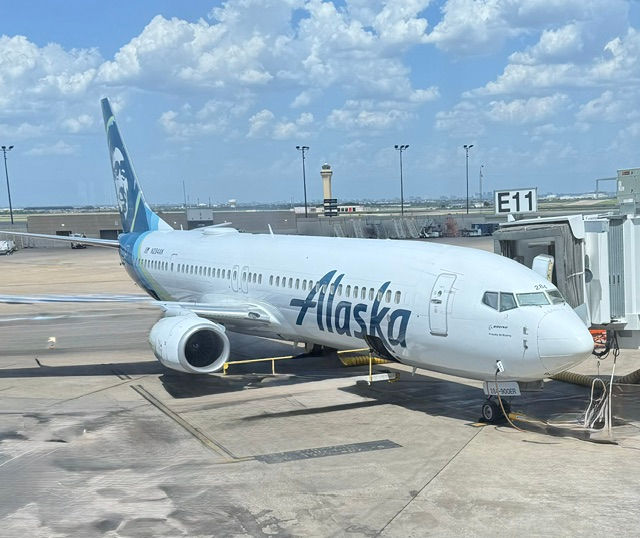
Alaska flies to Seattle from Gate E 11 at DFW and that necessitated another trip on the Skylink followed by a short walk to the departure gate. We boarded the aircraft close to 3:00 PM and again quickly found our favorite seats 2A and 2C on the port side of that B737-900 aircraft. This forward cabin was arranged just like American’s with 16 seats up front, but Alaska’s seats offered four more inches of legroom (41 vs 37), which made them feel more spacious. Trahn was the flight attendant assigned to our cabin. He deftly served pre-departure beverages during boarding and did so with a smile. It was obvious he enjoyed interacting with his customers and was very engaging and accommodating throughout the three hour and 42-minute flight. We departed DFW around 4:30 and were soon enjoying cocktails with warmed mixed nuts and pretzels. Alaska has a penchant for sustainability, so the ramekins were made of paper. Even the swizzle sticks were made of cardboard and there were no linens on the tray table. We enjoyed their famous Cheeseburger with all the trimmings along with a slice of Three-Layer Chocolate Cake for dessert.

Shortly before lunch was served, out pilot told us we had climbed to our assigned cruising altitude of 34,000 feet. This is a good point to briefly explain aircraft altitude. Planes flying westbound in the United States are legally required by Air Traffic Control to fly at even-thousand-foot altitudes under standard Instrument Flight Rules. At cruising altitudes, the standard vertical separation between aircraft is exactly 1,000 feet. This means that while our Alaska flight was cruising westbound at 34,000 feet, another aircraft could safely pass directly above it at 35,000 feet or directly below it at 33,000 feet. This 1,000-foot buffer exists thanks to a global aviation standard called Reduced Vertical Separation Minimum (RVSM) and is the primary reason why high-altitude airspace can safely handle so many planes at the same time.

Back to our journey. Our plane arrived in Seattle at 6:30 PM Pacific Time. It was a bit difficult to locate the shuttle bus for the DoubleTree hotel. Once we found our way to Island C though, we didn’t have to wait too long and arrived at the hotel in short order. The DoubleTree by Hilton Seattle Airport Hotel is a massive, full-service 3-star property located less than a mile from the airport. Originally built in 1969, the hotel is highly popular for both layover travelers and for those hosting large-scale corporate events. It was the ideal locale for this aviation gathering. I was assigned to room 425, a generously-sized king-bedded room with a balcony. My room also had a work desk with excellent lighting and plenty of USB ports and electrical outlets for various devices. What it lacked was an in-room safe, but overall the hotel proved to be a good place to call home during our time at the show.
I’ll tell you all about our aviation adventures in Seattle in future posts.
Until next time…safe travels.



Comments