
The Inception of In-Flight Entertainment


It’s hard to get bored in the air today. Seat-back screens and airline mobile apps offer hours of free entertainment on our smartphones or personal devices. A plethora of music and podcasts catering to divergent tastes are available with just one click while listening with noise-cancelling headphones. But, the early years of flight were quite different. Fighting boredom in the air before in-flight entertainment (IFE) and personal screens required passengers to pack their own entertainment and rely on low-tech activities. In those days, travelers carried thick, heavy novels, multiple paperbacks and magazines like Look or Life. Remember when airlines published their own magazines? Many passengers read them cover to cover and spent time studying the route maps as well in order to busy themselves. Puzzle books and games also helped while away the hours as did playing cards on tray tables whether it be solitaire or poker with seat mates. Solitary travelers often wrote letters while others struck up long conversations with other passengers. There simply wasn't much else to do.

Enter Tennessee cinema owner and film buff David Flexer. He'd been investigating how to bring movies onboard aircraft since 1956. Flexer later told Life Magazine how, after a transcontinental flight, he'd realized that "Air travel is the most advanced form of transportation and the most boring."This led to three years of testing and development to see if he could put films on to single reels and create a projector that could withstand turbulence while being light enough for the aircraft. Flexer's engineers were unconvinced and told him it couldn't be done. But, after pouring $1 million into the business, Flexer proved them wrong and his new company, Inflight Motion Pictures, was ready to take flight. At the time, airlines were competing for business on their transcontinental services, and Trans World Airlines (TWA) was first to agree to test out the equipment.

Before its official debut, the hardware was subjected to rigorous technical evaluation, regulatory safety testing and real-world test flights. Once TWA agreed to partner with Flexer, the airline dedicated a Boeing 707 to serve as a flying testbed. During the early months of 1961, engineers fitted the airplane with the prototype equipment and spent months flying that aircraft in order to fix bugs and monitor how the machinery responded to actual flight conditions. Since any new equipment had to meet stringent aviation standards, Flexer’s equipment underwent severe testing to satisfy the Federal Aviation Administration (FAA). Early prototype projectors were rejected because they failed to meet the FAA’s rigorous nine-G impact standards. The system had to be structurally secure enough not to break free and endanger passengers during severe turbulence or even a crash landing. Early designs were also discarded because they hung too low and didn’t leave enough headroom for flight attendants and passengers when walking down the aisle.

Finally, on July 19, 1961 TWA launched the world’s first scheduled in-flight entertainment (IFE) movie aboard a transcontinental Boeing 707 flight from New York to Los Angeles. It was a screening of John Sturges’ By Love Possessed. The drama starring Lana Turner and Efrem Zimbalist, Jr., was made available, along with pneumatic headphones, but only for those passengers in the First Class cabin. The Internet Movie Database sums up the plot with this descriptor: “Neurotic woman engages in an affair with the law partner of her impotent husband.” It was a rather steamy choice for the carrier, particularly considering the quasi-public environment of an airline cabin. Nevertheless, the in-flight movie concept was a roaring success.

According to John White in his paper titled A History of In-Flight Entertainment, the hardware consisted of a Kodak projection mechanism adapted to accommodate a 26-inch-diameter reel of 16mm film. Multiple reels had to be spliced together so that an entire film was contained on only one reel. The projection mechanism was then mounted horizontally to the ceiling of the aircraft cabin near the life-raft compartment. The public response to movies in the sky was phenomenal. It was said at the time that sophisticated travelers deferred departures and even switched destinations in to order to watch a certain movie. One research firm also estimated that the in-flight entertainment was responsible for six to eight more passengers for every TWA flight. It gave the carrier a major advantage in the airline market, quickly transforming an otherwise tedious method of travel into an entertaining experience and establishing In-Flight Motion Pictures as a pioneering industry leader. It was a major step in the progress of keeping the flying public suitably entertained on lengthy flights.

Competing airlines were initially hesitant. A group of carriers, led by Pan American World Airways and United Airlines, fiercely opposed the idea of showing movies in flight. They viewed the equipment as a costly gimmick and even tried to ban the practice through the International Air Transport Association (IATA), proposing a surcharge for passengers who wanted to watch films on airplanes. However, after a US Justice Department antitrust ruling struck down such restrictions, the commercial pressure from TWA's booming ticket sales forced other airlines to adapt. By early 1965, Pan Am embraced in-flight movies on their 707s flying the lucrative transatlantic routes. The carrier initially deployed a system using small, distributed black-and-white TV screens, but eventually transitioned to traditional projection screens. Pan Am famously branded its comprehensive entertainment system as Theater-in-the-Air, utilizing the pneumatic "stethoscope" headsets originally popularized by Flexer’s setups.
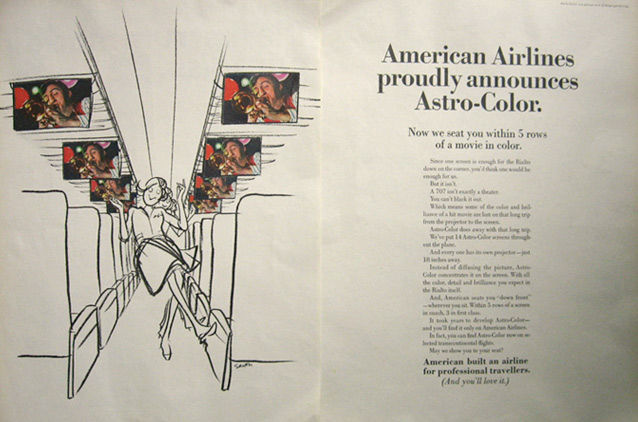
In 1962, Pakistan International Airlines (PIA) became the first non-U.S. international carrier to adopt Inflight Motion Pictures' 16mm system. They were directly assisted at the time by Pan Am's Technical Assistance Program, as they were leasing aircraft and receiving training from the American carrier. Other domestic giants quickly signed contracts with Inflight Motion Pictures to install overhead projection screens and audio systems across their fleets. American equipped select 707 jets with a system they called Astro-Color and United and Continental Airlines offered their customers similar entertainment onboard. By the end of the 1960s, in-flight movies were available to travelers on airlines across the globe, including Air France, Scandinavian Airlines, Swiss International Airlines and China Airlines.
Inflight entertainment (IFE) has since evolved into a massive system of high-tech options, transforming the passenger experience from a shared cabin screen to highly personalized, multi-screen digital hubs. The future may be even brighter as airlines continue to invest heavily in hardware, connectivity, and content partnerships to keep travelers engaged at 35,000 feet.
Until nest time…safe travels.


Comments