
Some Surprising Landmark Facts


Famous global sites achieve landmark status by transcending local geography to become symbols of human achievement, natural wonder, or shared global history. These world-class landmarks generally meet distinct criteria that elevate them to international recognition.They are instantly identifiable by people worldwide, often serving as the visual representation and defining image for an entire country. Many hold official designation as UNESCO World Heritage Sites, meaning they possess cultural or natural significance so exceptional they transcend national boundaries. Others represent a monumental leap in human capability, architectural design, or artistic expression for the era in which they were constructed. Most attract millions of international travelers annually, shifting from local reference points to major global tourism sites. But, did you know that many have rather surprising and interesting backstories? For example, were you aware that Big Ben isn’t actually the name of the iconic London clocktower? Or that the Great Wall of China is made, in part, of cooked rice? Or that the Empire State Building was originally intended to disembark blimp passengers at the very top? There’s more than meets the eye to many of the most famous landmarks in the world. Here we’ll take a look at several and learn some of the most fascinating facts you didn’t know about seven of Earth’s most iconic landmarks.
Christ the Redeemer - Rio de Janeiro, Brazil

Sitting atop 2,300-foot-tall Mount Corcovado in Rio de Janeiro, the iconic Christ the Redeemer Statue stands as a symbol of welcoming love with his arms stretched wide over Guanabara Bay. But, the 98-foot-tall structure with a 92-foot arm span isn’t immune to one major force of nature: lightning strikes. On average, the statue endures about three to five bolts a year, which are typically harmless. But, on January 16, 2014, a direct lightning bolt strike broke off a piece of the Redeemer’s right thumb, chipped its middle finger and damaged its head during one of Brazil’s most terrifying electrical storms in which 1,109 bolts were recorded in just three hours. During repairs, the Archdiocese of Rio used backup soapstone from the original quarry to fix the precious statue and also added additional lightning rods to the arms and head to absorb future high-voltage strikes.
Big Ben - London, England

When we think of Big Ben, we tend to think of the 314-foot-tall stone clock tower that rises above the Palace of Westminster on the banks of the Thames River in London. But, Big Ben is actually just the name of one of the bells inside, which was first struck on September 7, 1859. Of the five, Big Ben is by far the heaviest, weighing about 15 tons (the hammer itself is 440 pounds!), while the other four (which are called quarter bells) range from about one to 4.5 tons. The mighty bell strikes in the tone of the musical note E, as does the third quarter bell, while the first is a G, the second is an F sharp, and the fourth is a B. Big Ben’s official name is actually the Great Bell of Westminster, but its nickname is believed to hail from Welsh civil engineer Sir Benjamin Hall, who was president of the Board of Works when the bell was cast. As for the tower itself, it was originally known as St. Stephen’s Tower until 2012. It then became the Elizabeth Tower to commemorate Queen Elizabeth II’s 60th year on the throne in celebration of her Diamond Jubilee.
Eiffel Tower - Paris, France
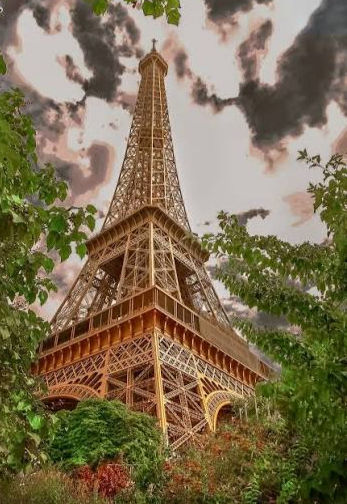
The Eiffel Tower was built with a temporary permit. Designed and built by Gustave Eiffel, a French civil engineer and architect, it was designed to stand for only 20 years after being built as an entrance arch for the 1889 World’s Fair. Many Parisian artists and writers hated the design at first and people called it an eyesore and a giant metal monster. The city planned to tear it down in 1909. Eiffel saved it by using it for radio antennas and scientific tests. He set up a meteorological station on top and the French military began using it for wireless telegraph radio communication. Its strategic value during military conflicts made the city cancel its teardown plan. Thank goodness. The Eiffel Tower was originally painted a hue called Venice Red, a reddish-browncontaining red lead called minium in order to prevent the paint from eroding. But now, the Eiffel Tower gets a new coat of paint every seven years to in order to preserve it. The most recent repainting began in early 2021 and was completed ahead of the 2024 Summer Olympic Games in Paris. This time, the Eiffel Tower was stripped entirely of its old paint layers and painted gold, a sparkling look that Gustave Eiffel himself envisioned when designing the structure. The tower’s golden look mimics Paris’ many golden limestone buildings.
Great Wall of China

Sticky rice is a staple of Chinese cuisine. Yet when scientists at Zhejiang University were researching the mortar used to build the structure, they were surprised to find the cooked grain among the limestone-and-water mixture. As it turns out, those who built the series of walls across 13,000 miles over the course of 2,000 years, found that the sticky rice-and-limestone mortar combination gave the paste more stability and a stronger hold, a formula actually invented during the Ming Dynasty. Builders mixed cooked sticky rice flour with slaked lime to create an innovative composite mortar. This organic-inorganic blend featured exceptional strength, elasticity, and water resistance, allowing sections of the Great Wall to withstand major earthquakes and resist weed growth.Though that seemingly tall tale turned out to be true, another popular myth, that you can see the Great Wall from space, doesn’t stand on such solid ground. Astronauts have said that from that great distance, the wall simply blends into the natural color of its surroundings.
Empire State Building - New York, USA

A blimp tethered to the top of the 1,454 foot tall Empire State Building seems like something you’d only see in a movie, but it was an actual idea at one point. In 1929, the building’s investors said they would boost the tower’s height by 200 feet to beat out the nearby Chrysler Building. But, beyond the bragging rights, the purpose of the extra height was to create a mooring mast so that a blimp could attach there for passengers to disembark into a private elevator and arrive on the streets of Manhattan within seven minutes. While the plan was deemed unsafe due to intense wind, a small airship did tether itself to the top of the tower for a few minutes in 1931. A Goodyear Blimp delivered a stack of papers onto the rooftop as part of a publicity stunt. And in 1983, an inflatable, eight-story-tall King Kong was attached to the top of the building for the film’s 50th anniversary. Sadly, the clever stunt didn’t last too long, because the balloon developed a hole in its left shoulder.
Taj Mahal - Agra, India

The Taj Mahal is widely known as one of the most striking structures on Earth, designed as a mausoleum for Mughal Emperor Shah Jahan’s wife, Mumtaz Mahal. Built from 1632 to 1648, the ethereal structure made of white marble is filled with contrasts when it comes to the gravesite itself. The graves of Mahal and Emperor Jahan are the only part of the mausoleum that are comparatively plain and dark in appearance, since Muslim law prohibits graves from expressing vanity. As a layer of protection, the four 130-foot-tall minarets on opposing sides of the building stand at a slight angle to fall away from the tomb, should they collapse. While the Taj Mahal has a reputation for being perfectly symmetrical, there is one asymmetrical detail. The casket of Mumtaz is placed in the center of the crypt, but the casket of Jahan was placed slightly off-center when he was buried in 1666. Oh, and the story that the emperor blinded the chief architect or cut off the hands of the workers so they could never build anything as beautiful again is nothing more than a popular urban legend with no historical evidence.
There’s more to come. I’ll fill you in on some additional interesting facts about several other landmarks in a future post.
Until next time…safe travels.


Great insights - Thanks!