
The Exceptional Jet Engine
- G. Rhodes

- Sep 27, 2025
- 4 min read

If you’ve ever taken a moment to look at your airplane from the boarding gate, perhaps you’ve noticed that little white swirl slowly turning in the very middle of the engine. Behind that swirl lies undoubtedly the most complex piece of engineering ever designed: the jet engine which powers your aircraft. "There's no metal-on-metal contact. They can go for thousands of hours — 60,000 hours — dependent only on air and fuel. The components are incredibly long-lasting," explained Dr. Magdy Attia, Professor of Aerospace Engineering at Embry-Riddle Aeronautical University. The first jet engines were turbojets in which all of the air was sucked into the engine and then passed through its core. They are no longer made for commercial use, Today, jets use bypass turbofans instead, which push almost all of the air they ingest around the engine core. They're quieter and far more efficient than turbojets.

Civilian turbojets stopped flying with the Concorde, which even used afterburners, something found only on supersonic fighters and bombers. The Concorde used afterburners for increased thrust during takeoff and acceleration through the sound barrier, injecting fuel into the engine exhaust to create a powerful boost, but this was very fuel-inefficient and was switched off by Mach 1.7 for supercruise at Mach 2 to conserve fuel for the remainder of the flight. The afterburners were a key technology for reaching supersonic speeds, providing the necessary power to overcome high-drag conditions and meet flight schedule requirements. Turbojet engines, like those on the Concorde, did not have any bypass at all, which made them very expensive to operate. To make that jet roar, the engines had to burn a lot of fuel.
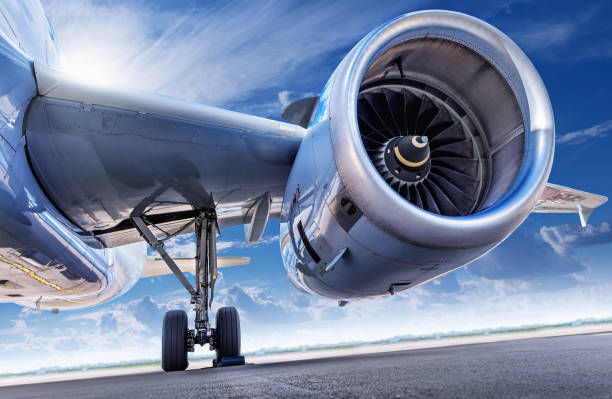
Jet engines work on the principle of Newton's Third Law, creating thrust by "sucking" air in, "squeezing" and "burning" it with fuel, and then "blowing" the super-heated, expanded gases out the back at high speed. This cycle—intake, compression, combustion, and exhaust—spins a turbine connected to the compressor, which powers the engine and generates the necessary force to propel an aircraft forward.

Operationally, the fan at the front at the front of the engine sucks in outside air. Ten percent of this air goes into the so-called "core" of the engine while the remaining 90 percent is sped up and bypassed around the core. The air that enters the core moves through a series of small, spinning blades attached to a shaft called the compressor. The act of spinning this air causes torque, which causes the air to speed up and increases its pressure. Fuel is then injected into the compressed air and ignited in a combustor. Next, the rapidly expanding, hot gas mixture passes through another set of fan blades called the turbine. These gases are caught by small blades on the turbine, causing the turbine to spin. It's this turbine that's so incredible.The spinning turbine turns a shaft that makes the compressors spin and turns the fan at the very front. A key takeaway? The whole point of the engine core is to turn the fan at the front, not to provide most of the thrust itself.

How much air is needed to provide enough thrust to generate lift? Jet engines, especially the high-bypass turbofans used on commercial airliners, pull in a tremendous volume of air to generate thrust. A modern jet engine can ingest up to 1.5 tons of air per second at takeoff. To help visualize this, one engine can pull in the volume of air equivalent to 53 UPS trucks every second. A Boeing 747's engines can ingest more than 2,200 pounds of air per second at takeoff. A GE90 Engine, used on the Boeing 777, can suck in over 1,300 kilograms of air per second at full power. By any calculation, these are enormous volumes of air.

The energy created by the fan blades is stunning. And every engine manufacturer seems to have a colorful way to explain the energy captured in one single blade. One manufacturer said the energy in a single operating fan blade could launch a small car over a seven-story building. Another touted it's enough to hoist nine double-decker buses (or 13 bull elephants). The fan blades for the Pratt & Whitney Engines are made with high-strength aluminum alloy with a titanium leading edge. Other jet-engine makers use hollow titanium blades or blades wrapped with carbon fiber. And, the fan blades are mini wings, generating lift.

Airplane takeoff is one of the most thrilling and essential stages of any flight. Watching a massive aircraft accelerate down the runway before lifting off the ground is a sight to behold and might lead one to wonder, just how fast must a plane be traveling to achieve lift? On average, most commercial airplanes require speeds between 150 and 180 miles per hour. While a minimum takeoff speed is required for all aircraft, powerful jet engines allow for lower takeoff speeds and heavier payloads by increasing the forward force. The specific thrust setting and resulting takeoff speed are calculated based on the aircraft's weight, runway length, and weather conditions, with pilots adjusting the thrust to reach a safe speed.
And what about that little white swirl in the middle of the engine? It’s only there to let everyone know whether or not the fan is spinning.
Until next time…safe travels.


Comments