
The Iconic Lockheed Constellation


When thinking about iconic airplanes from aviation history, most people will mention aircraft like the Boeing 747, the Lockheed L-1011 TriStar, or the Concorde. But, aside from these jet planes, many earlier civilian airliners are often overlooked. Before jet aircraft became the norm, the world was flying on piston-driven aircraft like the Lockheed Constellation, sometimes affectionately referred to as “the Connie" by enthusiasts. At its peak, this propeller airliner was considered one of the best commercial passenger planes. Let's take a look back at this famous aircraft and see how it influenced what we we fly today.

All modern airliners are pressurized at 8,000 feet, allowing their passengers to breathe and feel comfortable even if they fly at 30,000 feet or higher. While we take this for granted today, it wasn't the norm until the Lockheed Constellation made this technology popular for the flying public. Pressurization allows aircraft to fly above 10,000 feet without requiring oxygen for every passenger. At these altitudes, the airplane will also fly above most weather, making trips safer and more comfortable. Although Boeing introduced the first pressurized airliner in 1940 with the Boeing 307 Stratoliner, the Lockheed Constellation popularized it after World War II. That's because Boeing only made ten 307s, while Lockheed built and sold well over 800 Constellations. Since carriers like Trans World Airlines (TWA), Pan American World Airways (Pan Am), BOAC, and Air France operated the Constellation on popular routes like New York to London and Paris as well as between Bermuda and New York, many people had their first commercial flight aboard the Connie.

In addition to its cabin pressurization, the Lockheed Constellation stood out from its peers due to its shape. Unlike its contemporaries, which featured cylindrical cigar-type fuselages and usually large, single tails, the Connie had a unique dolphin-like body and three smaller tails at the rear empennage. Lockheed used the triple-fin tail design over a larger single-piece tail to ensure the large airliner would fit in existing hangars. It also featured modern features (for the 1940s) like de-icing systems and hydraulic controls, allowing it to fly even in inclement weather. The Connie used durable tricycle landing gear capable of carrying a heavier payload and was raised higher off the ground than other aircraft. It also had four radial engines, as opposed to the two and three-engined airplanes popular at the time. Lockheed also made several variants of the Constellation, with the smallest capable of sitting 60 passengers and the largest model having a maximum capacity of over 100 people.

One of the aircraft’s biggest advantages was its speed. Although the first model had a top speed of just 313 mph, later models could reach up to 377 mph, making it faster than its contemporaries, such as the Douglas DC-6, which topped out at around 315 mph. This top speed made some variants faster than some popular World War II fighters, such as the Japanese Zero (350 mph). This was a feat for Lockheed, especially as the Constellation was much larger than those flying fighting machines. The base variant Constellation L-049 could carry over 36,000 pounds or more than 18 tons. This capacity, coupled with its speed, made the Constellation a good candidate for military service, even though it was initially designed as a civilian airliner. Although TWA was the first to order the Constellation in 1940, the US Army Air Force (USAAF) took over this order when the US entered World War II, and the planes would go on to aid American forces.
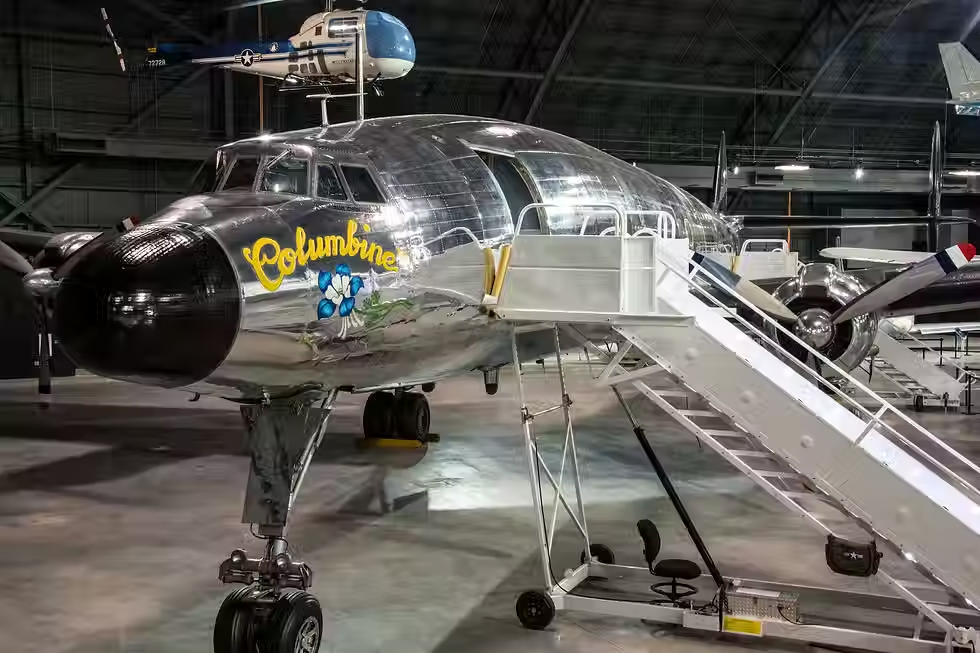
Its service continued after the war, when, between 1948 and 1955, the newly-founded US Air Force ordered 150 of the L-749 variants, giving it the C-121A designation. Because of the large cargo capacity of the Connie, they were indirectly involved in the Berlin Airlift. Although they were too large for the runways at Berlin's airports (only smaller aircraft like the Douglas DC-3 flew directly to the city), the Connie's large size was instrumental in flying essential cargo from the US to England or West Germany before that cargo was flown onwards to Berlin. Some of these aircraft were eventually converted into VIP transport aircraft, with one assigned to General Douglas MacArthur as his personal transport during the Korean War. Two Lockheed Constellations were also converted for Presidential use by Dwight Eisenhower. They were given the names Columbine II and Columbine III, with the former being the first aircraft to be given the Air Force One callsign when the US President was on board.

After World War II, the Constellation flew once again for TWA, its original operator. The carrier used it for their lucrative transatlantic routes. The construction of longer runways in Europe and the US for the war effort made long-distance land-based aircraft flight more viable, thus allowing aircraft like the Connie to become more prevalent. TWA, the airline that made the initial order for the Connies, started flying them in 1946 between New York and Paris. Soon after, Pan Am launched their round-the-world Flight # 001 with the L-049. Eventually, other airlines bought the aircraft, among them Air France, BOAC, Qantas KLM and Lufthansa. Although the Constellation was a great airliner, the advent of the “Jet Age” in the late 1950s meant it wouldn't stay on top for long. It was a propeller-driven aircraft powered by piston engines, which meant that it was slower, less efficient, and not as comfortable as the newer jet-powered planes coming onto the market.

De Havilland introduced the Comet in 1952, the first jet-powered airliner in the world. It was powered by four jet engines, giving it a cruising speed of 460 mph. Although the Comet was grounded in 1954 due to a series of crashes, it wasn't too much longer until Boeing's first jetliner, the 707, and the competing Douglas DC-8 arrived just four years later in 1958. The popularity of jet travel would eventually seal the Lockheed Constellation's fate. In 1968, ten years after the 707s and DC-8s entered service, the Connie made its last scheduled passenger flight in North America with Western Airlines traveling from Anchorage to Juneau, Alaska.
The Lockheed Constellation was an iconic airliner. Its popularity with carriers and the flying public was due to its advanced technology as evidenced by its pressurized cabin, its speed and its range, The aircraft enabled smoother, faster, long-haul flights above most weather. That, coupled with its distinctive, elegant design, symbolized luxury and helped usher in the "Golden Age of Air Travel" around the globe. The Connie was considered the premier "propliner" before jets took over the skies. Its ability to offer comfortable, non-stop transcontinental and transatlantic flights with luxurious amenities made it a passenger favorite and a status symbol with an unrivaled place in aviation history.
Until next time…safe travels.
The Connie was more than simply a passenger plane. In fact, it also had a storied military career, especially as it made its first flight fight in 1943 in the middle of the Second World War when it served as a long-range fast transport aircraft for the US military. Known as the C-69,
The last piston airliner


Comments