
What Happened to the Flight Engineer?
- G. Rhodes

- Sep 13, 2025
- 5 min read
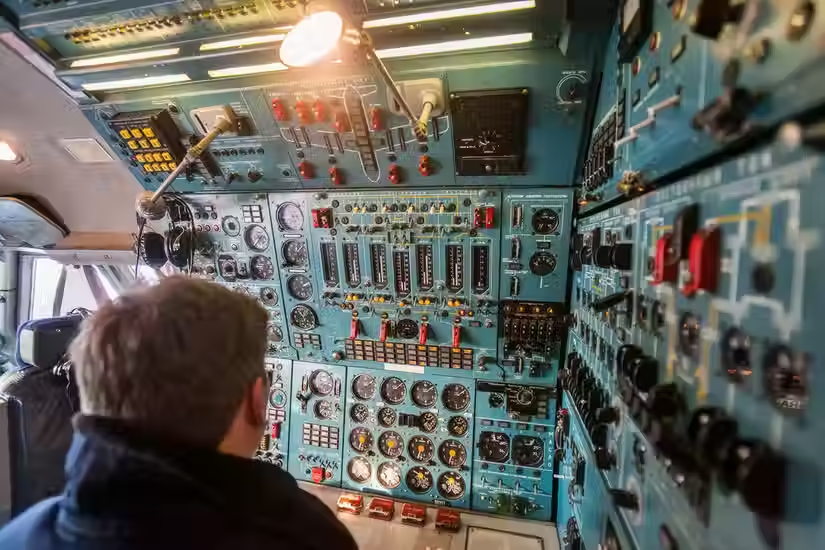
Today, aircraft typically require only two flight crew: the Pilot and the Co-Pilot. But, this wasn't always the case. Before the development of more sophisticated microprocessors and computers, various larger commercial aircraft needed a third officer in the cockpit, namely a Flight Engineer whose job it was to help monitor the aircraft and ensure it was functioning properly. Flight Engineers were crucial members of the flight crew in older aircraft, primarily responsible for monitoring and managing the aircraft's mechanical and electrical systems, ensuring their proper functioning during flight. They were essentially the systems experts in the cockpit, separate from the Pilots who focused on flying the aircraft.

FAA certificates require certain types of aircraft to have Flight Engineers. Boeing examples include the Boeing 307, Boeing 377, Boeing 707, Boeing 727, and early model Boeing 747s. Douglas aircraft needing them included the DC-6, DC-7, and early models of the DC-8 and DC-10. Other examples include early Lockheed L-1011 TriStars, early Airbus A300s, and the Lockheed Constellation. Smaller twin-engine jets like the Boeing 737, DC-9, and Caravelle were not considered complex enough to require a Flight Engineer. Meanwhile, by the time wide-body jets like the Airbus A310, Airbus A300-600, Boeing 767, McDonnell Douglas MD-11, and later wide-body models were built, technology had advanced to the point that they were no longer needed.

These days, the aircraft's complex systems are monitored and adjusted by onboard microprocessors and computers, rendering the role of a Flight Engineer redundant. At the same time, all the older commercial aircraft that required a Flight Engineer have since retired from scheduled passenger service with US-based airlines. The Flight Engineer is one of those roles, like telephone operators, that new technological advancements created, only to be made obsolete by subsequent technological breakthroughs. Beginning in the 1980s, small and powerful integrated circuits were developed along with other innovations, including digital technology. As a result, today’s modern aircraft are only two-pilot flight deck airplanes.

The final US-built commercial aircraft requiring a Flight Engineer may have been a Boeing 747-200F made for Japan’s Nippon Cargo Airlines. That aircraft was the last Boeing 747 Classic ever built and, at nearly 34 years old, it’s now flying for Fars Air Qeshm an Iranian cargo airline. Northwest Airlines’ Boeing 747-200s were likely the last passenger aircraft from a major US carrier to use Flight Engineers. These Boeing 747-200s were used as charter aircraft in their final years, retiring in 2009. There are very few older civilian aircraft now flying that need Flight Engineers. Today, it’s more common to find Flight Engineers on military aircraft and old Soviet/Russian-built planes. The iconic Antonov An-225 required multiple Flight Engineers, while the Antonov AN-124 the largest military transport flying today, requires a Chief Flight Engineer and an Electrical Flight Engineer with a total crew of six. The US Air Force C-5M Super Galaxy requires two Flight Engineers. Boeing didn't eliminate the need for a Flight Engineer for its Boeing 747 jets until the 747-400 introduced in 1988. The two Air Force VC-25A s designated for Presidential transport and known as Air Force One are based on the 747-200B aircraft and does require Flight Engineers.

There may yet be one corner of the world where commercial aircraft could once again be built calling for Flight Engineers. In 2022 after Russia invaded Ukraine, the West imposed crippling sanctions on their aviation industry, effectively halting its commercial aircraft production overnight. As of mid-2025, Russia has failed to deliver any commercial aircraft, barring a few Superjets assembled with pre-stocked components. As Russia is cut off from purchasing Western components, it’s looking backwards to restarting production of old Soviet-era obsolete passenger jets like the Tupolev Tu-214 and Tu-204, as well as the Ilushin Il-96. While Russia produced updated variants, those were made without Western components. According to the BBC, writing in December 2024, Russia was considering putting the older, more obsolete, but simpler variants back into production. These old Il-96s and Tu-214s require flight crews of three and have very low levels of automation. Pilots need to keep track of things like making sure the wings remain balanced with the same amount of fuel. In order to fly these aircraft, Russia would need to reopen a training school for Flight Engineers and to train Pilots to fly antiquated systems. It's unclear if these aircraft will actually be made. Aeroflot has stated it doesn't want the Tu-214s, while FlightGlobal reported in 2024 that Russia was looking for ways to produce the aircraft requiring a flight crew of only two.

The most recent example of an aircraft built needing a Flight Engineer is the unique Scaled Composites Model 351 Stratolaunch. That distinctive twin-boom, six-engined aircraft has components of two stripped-down B747s and is currently used to launch test hypersonic missiles. This unique, twin-fuselage aircraft, the largest in the world by wingspan, was designed to air-launch rockets into space from high altitude. First flown in April 2019, its immense 385-foot wingspan provides a stable platform for carrying and launching payloads, initially intended for the now-abandoned SpaceX Falcon 9 Air Program, and later adapted for Grumman’s Pegasus XL Rockets and other high-speed flight testing services. The aircraft has been sparingly flown, having only been airborne two dozen times in the past six years.

The march towards autonomous systems continues. The prospect of pilotless commercial aircraft is becoming increasingly feasible with advancements in technology. Military aircraft, such as the new B-21 Raider Strategic Bomber is known to be optionally manned, while the Tempest/GCAP Sixth-Generation Fighter Jet is also being developed to be optionally manned. Pilotless commercial aircraft, or autonomous planes, are moving closer to reality, with advancements in autopilot systems, AI technology, and increasing recognition of a pilot shortage driving their development. Autonomous cargo planes are already being tested and are expected to enter commercial service in the near future.
Companies are developing systems for fully autonomous taxiing, takeoff, and landing, as well as AI-powered flight control. But, while pilotless commercial aircraft may not be on the horizon anytime soon, the role of Flight Engineer has long since been eliminated.
Until next time…safe travels.


Comments