
A Look at Military Transport Aircraft


Military transport aircraft are often based on civilian counterparts. Others are custom-built in response to bids or tenders issued by governments for aircraft to meet specific needs. Military aircraft are designed to withstand more extreme conditions and are built or modified to fly at higher altitudes than civilian aircraft. One of the key differences between commercial and military aircraft is the equipment onboard. Military aircraft often have specialized avionic equipment for navigation and communication, including encrypted radios, advanced radars, and in-flight refueling capabilities. Engines can also differ between versions as military missions prioritize response time, whereas commercial airliners focus on reducing fuel consumption and noise.

Military transport aircraft are specialized, heavily built aircraft designed to airlift troops, heavy equipment and supplies. They are broadly categorized into tactical transports, which operate close to the frontline, often on rough and unpaved runways, and strategic transports, which move heavy loads over intercontinental distances. Because the fleet mixes and capabilities vary significantly between global air forces, understanding how these aircraft function helps define the logistics of global defense and humanitarian missions.
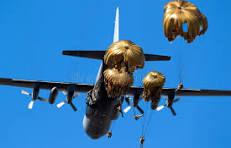
There are any number of core roles and capabilities involved. Modern airlifters are highly versatile platforms designed for a multitude of military and civilian support missions. Strategic airlifts move massive amounts of cargo on a global basis, such as battle tanks or armored vehicles and large troop formations. Strategic airlifts drop paratroopers and deliver crucial supplies directly into combat zones or remote, isolated areas. Airdrop operations are those which safely deploy heavy equipment, vehicles, and pallets mid-flight. Aeromedical evacuations transport critically injured personnel to higher-echelon medical facilities while humanitarian relief transports deliver emergency aid, medical supplies and rescue teams to disaster-stricken areas.
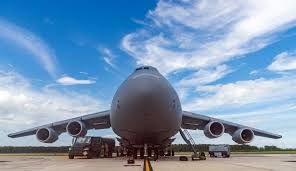
The largest aircraft in the US Air Force inventory is the the C-5M Super Galaxy strategic transport. Its primary mission is to move cargo and personnel for the Department of War. The C-5M is a modernized version of the legacy C-5 designed and manufactured by Lockheed Martin. Currently, the US Air Force owns and operates 52 Super Galaxies. They are stationed at Dover Air Force Base (AFB) in Delaware, Travis AFB in California, Lackland AFB in Texas and the Westover Air Reserve Base in Massachusetts.The C-5M Super Galaxy is equipped with five sets of landing gear, 28 wheels, four General Electric CF6 commercial engines and a state-of-the-art maintenance diagnostics system.

Each aircraft can carry oversized cargo across intercontinental distances and can take off and land on relatively short runways. Both the nose and aft doors open, allowing ground crews to simultaneously load and off-load cargo from both ends, reducing cargo transfer times. The full-width drive-on ramps at each end also enable double rows of vehicles to be transported. The maintenance diagnostics system has the ability to record and analyze data from more than 7,000 test points, reducing maintenance and repair time. The C-5M, with a cargo load of 281,001 pounds, can fly 2,150 nautical miles, offload and fly to a second base 500 nautical miles away from the original destination without aerial refueling. With aerial refueling, the aircraft's range is limited only by the crew’s endurance.

Another massive, highly versatile military transport aircraft operated by the US Air Force and several allied nations is the C-17 Globemaster III, which is manufactured by Boeing. Designed to deliver heavy equipment, troops, and humanitarian aid, it uniquely combines intercontinental strategic range with the ability to land on short, austere airstrips often consisting of dirt, gravel or packed earth. Measuring 174 feet long with a wingspan of roughly 170 feet, the cargo bay itself is 88 feet long and 18 feet wide. The Globemaster can carry over 85 tons of cargo, including heavy armor or more than 100 fully-equipped paratroopers. With a cruising speed of nearly 530 miles per hour, this plane has a service ceiling of 45,000 feet. And, despite its size, the C-17 can land on runways as short as 3,500 feet. The engines on the C-17 feature thrust reversers that direct air upward and forward. This prevents the engines from ingesting dust or debris from dirt runways and allows the aircraft to physically back up on the ground. The aircraft can also be refuled mid-air, giving it virtually unlimited global range. First flown in 1991, the Globmaster has been the workhorse for both military and humanitarian operations. It was used heavily in the conflicts in Iraq and Afghanistan and regularly provides disaster relief. Notably, during the August 2021 evacuation of Afghanistan, a single C-17 set a record by safely carrying 823 evacuees out of Kabul on one flight.

While it looks similar to earlier Hercules models, the Lockheed Martin C-130J Super Hercules is effectively a completely new aircraft with unmatched operational flexibility. The plane features updated turboprop engines, a digital glass cockpit and highly adaptable cargo capabilities. Beyond basic troop and cargo transport, it operates as an aerial refueler, a medical evacuation aircraft, a maritime patrol vehicle, a search and rescue plane, and aerial firefighter. The cargo bay can be reconfigured in minutes for different mission requirements without needing specialized ground equipment. And, the Enhanced Cargo Handling System (ECHS) allows the crew to transition the floor from flat walking surfaces to heavy-duty pallet rollers mid-flight. The rear cargo ramp can even remain open during flight, enabling pinpoint-accurate drops of supplies, heavy equipment, or paratroopers. The Super Hercules is powered by four Rolls-Royce AE2100D3 turboprop engines equipped with six-bladed composite propellers. This allows it to cruise at lower speeds and altitudes, making the aircraft ideal for dropping supplies or even refueling helicopters. Despite having four engines, it’s highly efficient, boasting a 20% greater fuel efficiency than some two-engine turbofan aircraft.
Military transport aircraft are incredibly powerful, designed to haul massive multi-ton payloads such as main battle tanks and helicopters over thousands of miles. Rather than matching the speed of a fighter jet, their "power" lies in their brute force, their thrust, and their immense weight-lifting capacity.
Until next time…safe travels.



Comments