
Atlanta's Taxiway Victor Broke New Ground


Atlanta’s Hartsfield-Jackson International Airport (ATL) is the busiest airport on the planet. Last year, the airport processed more than 106.3 million passengers, eclipsing the second and third-busiest airports; Dubai International Airport (DXB), through which 95.2 million passengers were processed, and Tokyo’s Haneda Airport (HND) which welcomed 91.7 million. With so much air traffic in Atlanta, it's crucial that the airport's runways and taxiways are well-organized and efficient to keep the aircraft moving smoothly. One critical component in achieving this was Taxiway Victor.
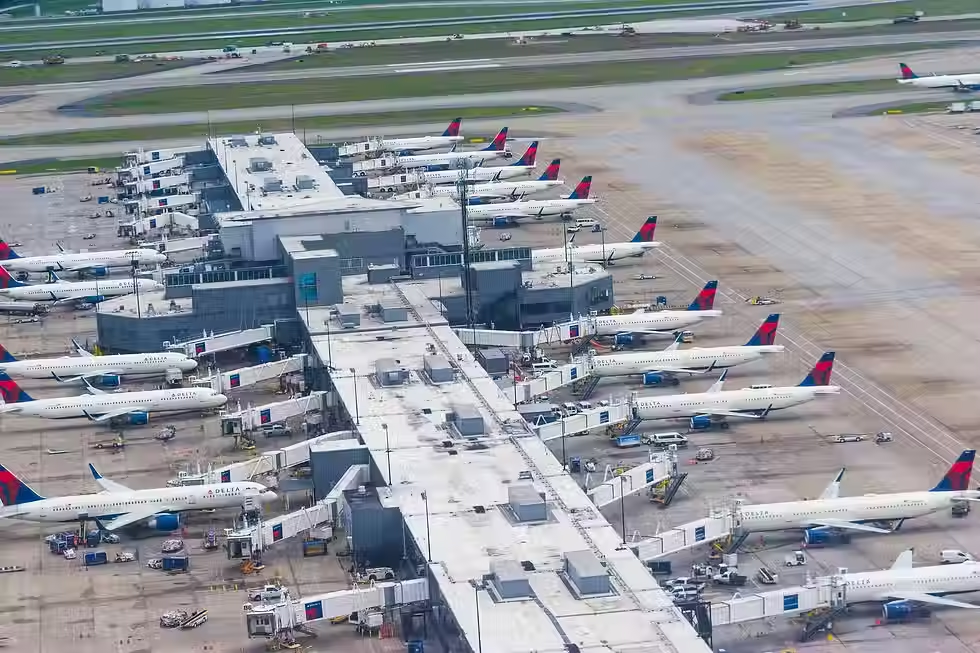
The Atlanta Airport operates with five nearly parallel east-west runways, with the four primary and most heavily used being 8R/26L and 8L/26R or their western counterparts 9R/27L and 9L/27R. These runways were designed for maximum efficiency for high-volume traffic, allowing concurrent takeoffs and landings with consistent wind conditions. All five of their east-west runways align with consistent, non-disruptive prevailing winds allowing massive, simultaneous traffic flow. Often, the inboard runways closer to terminals, such as 8R/26L, are used primarily for departures, while outboard runways like 8L/26R are used for arrivals to optimize traffic flow. This parallel configuration contributes to ATL being the world’s busiest airport by allowing multiple aircraft to land and take off at the same time, with a capacity of over 100 departures and arrivals per hour.
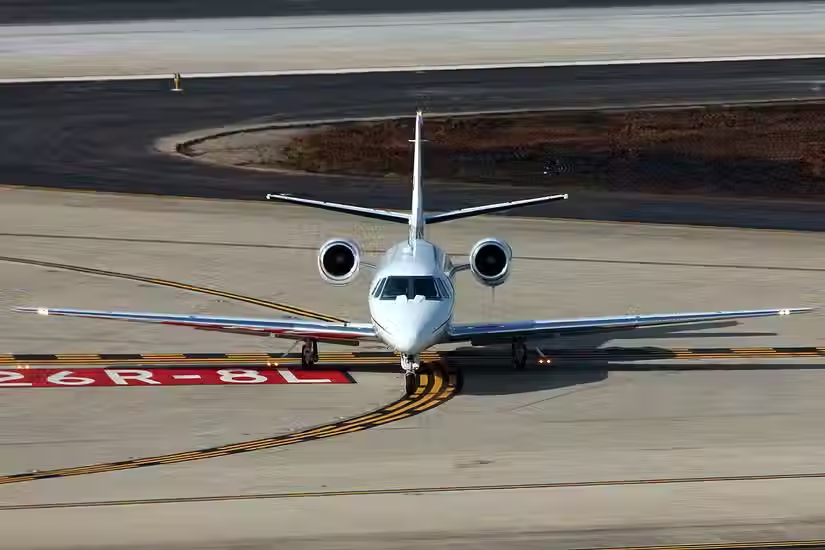
Prior to the construction of Taxiway Victor, up to 700 aircraft per day would have to wait in line for clearance to taxi across the other active runway to get to the terminal gates. Not only did this frustrate passengers who were eager to get off the plane, but it also increased fuel burn and led to operational delays for airlines and their ground teams.Thus came the idea of building a taxiway that would solve this issue: a $42-million, three-quarter-mile strip of pavement known as Taxiway Victor. According to Aviation Pros, the project was expected to save precious time for passengers, as well as trim $26 to $30 million off airline fuel costs each year.
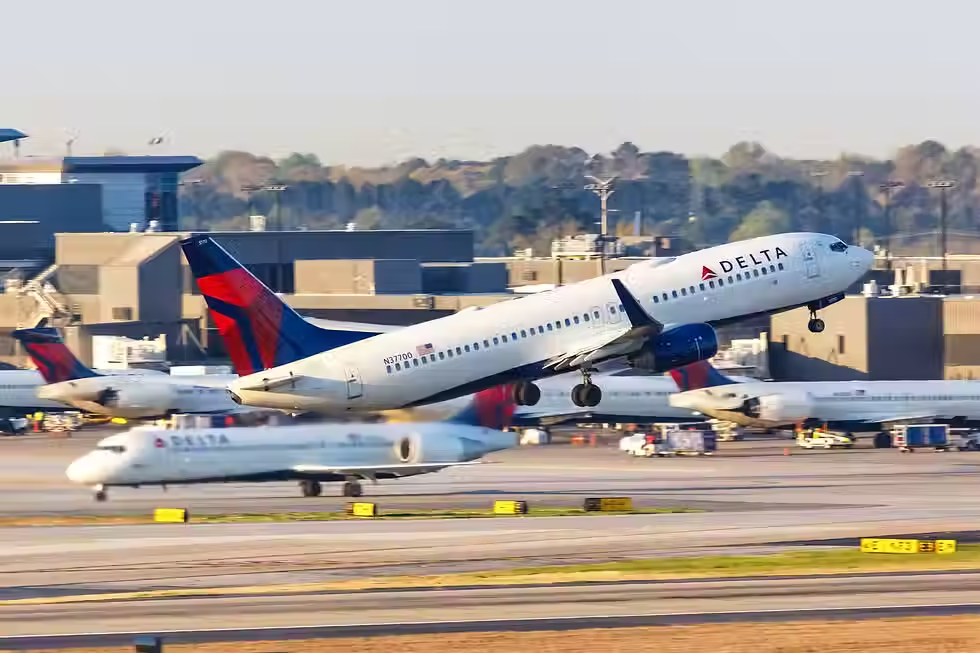
Taxiway Victor, or "The Loop,” as pilots call it, is an end-around taxiway that runs around the runway safety area beyond the departure surfaces. It's now a vital component of the airport's taxiway system and plays a critical role in ensuring that planes can move around the airport efficiently. One of the main advantages of Taxiway Victor is that it reduces taxi time for aircraft. The taxiway is located between the north and south runways, and it provides a shortcut for planes that have landed on the north runway and need to taxi to the south side of the airport. Instead of holding short of runway 8R/26L, aircraft arriving on 8L/26R are now able to proceed directly to the terminal area. Another benefit of Taxiway Victor is that it helps to reduce congestion on the airport's other taxiways. By providing an alternate bypass route for planes, it allows airlines to achieve quicker turnaround times, avoiding delays on subsequent flights. And it goes without saying that safety, too, is enhanced, with fewer possibilities of runway incursions.

The end-around taxiway is a crucial component of Atlanta’s taxiway system. While a significant investment for the airport (half financed by the Federal Aviation Administration [FAA] and the remainder by passenger fees), the construction of this taxiway resulted in a valuable addition to the airport's infrastructure. In fact, the taxiway has been so successful that it’s become a model for other airports looking to improve their own taxiway systems. Following the official opening of Taxiway Victor in 2007, Dallas Fort Worth International Airport (DFW) opened its southeast side end-around taxiway in 2008. A second on the northeast side opened in 2022, and a third was completed last year. The Atlanta Airport unveiled its latest end-around taxiway, dubbed Taxiway Whiskey, in November 2022, becoming the second US airport to have two such taxiways.

As the world's busiest, Hartsfield-Jackson Atlanta International Airport is certainly a prime candidate to make good use of such end-around taxiways. Over the years, the airport has completed a number of other infrastructure projects designed to improve its operational performance and passenger experience, with its Concourse D project currently underway and on schedule. This $1.4 billion project is scheduled for completion in June 2029 and is being finished in phases while the concourse remains actively in use. As of late 2025, the Concourse D widening project has reached major milestones, with Phase 2 completed last September featuring new, wider gates (D32-D36) with higher ceilings, updated restrooms and increased, modern seating. The expansion project is using a unique building technique with prefabricated modules to modernize and widen the concourse while not disrupting operations for thousands of passengers who shuffle through per day.
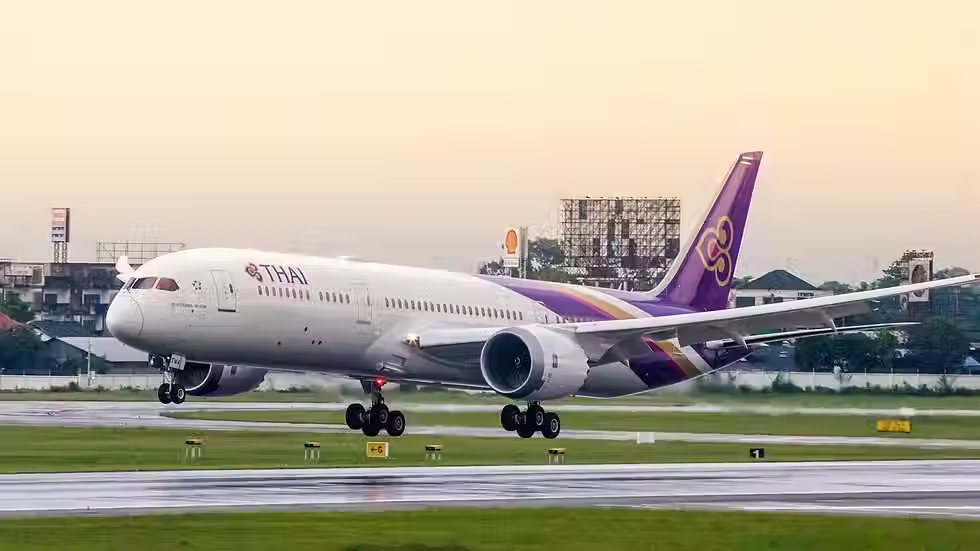
Since the construction of Taxiway Victor in Atlanta, the concept has since been adopted at the Detroit Metro International Airport (DTW), which now lays claim to three such end arounds and the Charlotte-Douglas International Airport (CLT), which commissioned a North End-Around Taxiway in early 2025 to reduce active runway crossings and thereby improve safety while saving time. Internationally, eight airports have constructed such taxiways. In Europe, Germany’s Frankfurt Airport (FRA) now features a key end-around taxiway associated with the Northwest Runway 07L/25R to facilitate efficient traffic flow, particularly for landing aircraft. Turkey’s Instanbul Airport (IST) also features several end-around taxiways to allow aircraft to pass around active runways without crossing them, thereby enhancing capacity. This dramatically improved the airports’s simultaneous runway operations. The concept has taken off in Asia at no fewer than five airports, including Singapore Changi (SIN), Shanghai Pudong (PVG), Guanghzhou Baiyun (CAN), Beijing Daxing (PKX), Tokyo Narita (NRT) and Bangkok Suvarnabhumi (BKK).
End-around taxiways make arriving passengers significantly happier by reducing taxi-in times by approximately four to eight minutes per aircraft and improve safety by removing the need for planes to cross active runways. These loop taxiways also prevent bottlenecks, reducing the frustrating tarmac delays and waits associated with landing on outboard runways. Now that’s something to smile about.
Until next time…safe travels.



Comments